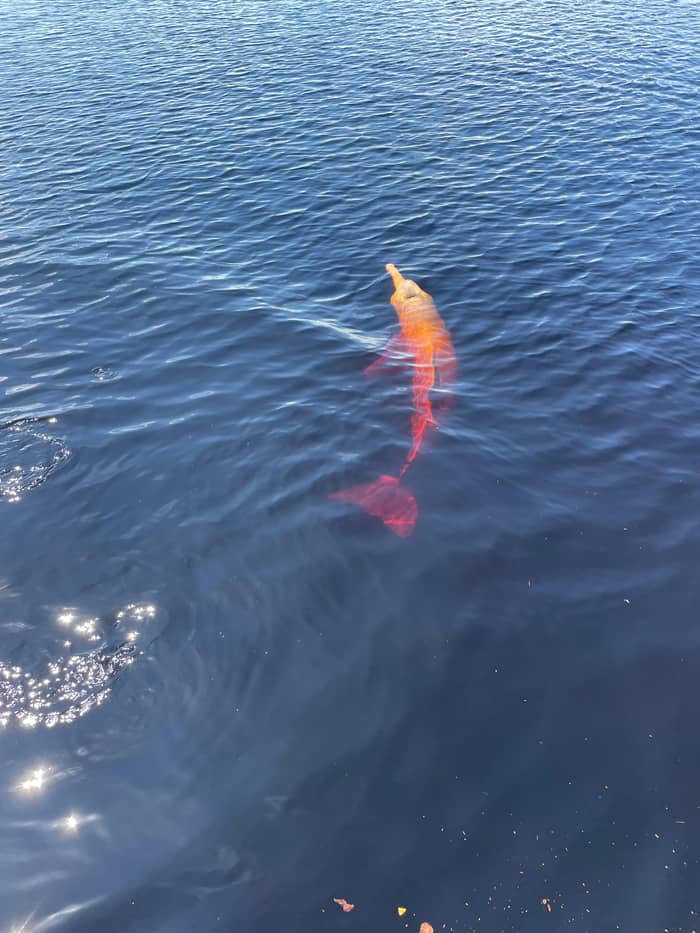
Landscape
Wide from the canoe
A calm surface and the forest
- Length1 day
- Reviews431
- GuideEnglish
Guides
Language
Currency
Find open datesfrom $140 · free to cancelPacking and prep checklist
Quick summary
Pictures of pink dolphins in the Amazon need patience and a fast shutter, because a boto surfaces briefly, and lifting one out of the water for a photo counts as mistreatment.
Photo essentials
Checklist · 9 points
Tick off each point as you complete it. This device keeps your progress.
0 / 9 ready
You are good to go. Pick your date for the jungle day, and the rest is settled.
Secure your spotA boto surfaces for a moment and is gone. Here is what to expect in your frames, how to prepare your camera or phone for an open canoe, and how to take the shot without crowding the animal.
Editorial team, pinkdolphinsamazon.quest · Updated November 12, 2026 · 6 min of reading
Summary view
Good pictures of pink dolphins in the Amazon are rarely lucky accidents. They come from understanding how the animal behaves. The boto has to rise to the surface at regular intervals to breathe, though it can remain underwater for long periods, and a biosonar helps it find fish and steer in the water.1 You get a moment at the surface, then nothing for a while.
The dark river adds to the challenge, and so does the animal itself. The boto has a long beak with short, sparse bristles and small eyes, and its dorsal fin is long and low like the keel of a boat.5 There is no tall fin to catch the eye. What you see on a surface pass is a back, a low fin and sometimes the beak.
Group size works in your favour only a little. Survey crews in central Amazonia logged one to four animals in 99% of the groups they met, so you are watching a single dolphin or a small cluster rather than a pod.6 A second chance within the same shot is rare, so decide in advance what you will do when the first fin appears: raise the camera, hold steady and press early rather than waiting for the perfect moment.
Where to shoot
| Setting | What you can shoot | Watch out for |
|---|---|---|
| Canoe on a lake | A back breaking the surface | Spray and no cover |
| Floating platform | Closer passes, group shots | Crowding at the edge |
| In the water | Underwater and eye-level frames | Loose items falling in9 |
| Sunset ride | Warm light, sky reflections | Fading light |
| River beach | Wide scenes of the Negro River | Glare on the water |
Settings are described as the listings record them; what appears depends on the animals on the day.
The pink in the name is real but variable. The colour ranges from dark grey to bright pink depending on age and sex, calves are dark grey, and sexually active adult males are much pinker because of scars from fights.2 So the animal in your picture may be a grey youngster, a pale adult or a flushed male, and all of them are the same species.
The head is flexible. The seven unfused neck vertebrae let the boto move its head in every direction, and its body is robust, streamlined and very flexible compared with other dolphins.8 You may catch a turn of the head or a bend of the body that a rigid animal could not make, which makes the shot more characterful than a straight side view.
Scale is worth recording for your caption. The largest recorded males measure 2.55 m and 200 kg, and the largest females 2.25 m and 155 kg.4 Include a bit of the canoe, a hand or a floating platform in the frame when you can, because without a reference the animal looks smaller than it is on a screen, and a caption with the real size lets the viewer judge what they are looking at.
A shot step by step
Before the trip
The canoe has no cover, so bring a dry bag.
At the stop
One record says photos with the wild animals are not allowed.
When one surfaces
A boto surfaces regularly but can dive for long periods.1
In the frame
Males can be 2.55 m long, so frame wide.4
Afterwards
Say it is the boto, an animal assessed as Endangered.7
Start with the boat. The canoe used on our jungle day is a basic wooden boat with a motor and no cover, so sun, spray and rain all reach your gear. A dry bag, a lens cloth and a lens hood are worth more than an extra lens. Use a strap or lanyard, because researchers note that objects falling into the water can be swallowed by the animals.9
For settings, think speed. Choose a fast shutter speed, burst mode and continuous autofocus on a camera, and on a phone use burst or a high-frame-rate video mode and lock exposure for the water. Underexpose slightly to keep the pink back from burning out against the dark surface, and keep the sun behind you where the boat allows it.
Frame wider than you think you need. Dolphins surface unpredictably, and a wide frame lets you crop to the animal afterwards. Pre-focus on a spot where you saw one surface and wait with the camera ready. Skip the flash around wild animals, and never chase a dolphin with the boat to get closer. Let the guide place the canoe, and accept that some surfacings will be behind you or too far away to use.
Pick your gear
Say how you shoot and see what to pack for the canoe.
If I shoot on my phone
A dry bag and a lanyard
The canoe has no cover, and objects that fall in can be swallowed.9
If I shoot on a camera
A fast lens and a hood
Pre-focus where one surfaced, because it dives for long periods.1
If I want underwater frames
A waterproof housing
The dolphin project offers the chance to enter the water.
If I want sunset pictures
A spare battery
The ride runs until sunset on our jungle day.
If I want a group picture
Ask the guide first
One record says photos with the wild animals are not allowed.
Choose your frame
Landscape
A calm surface and the forest
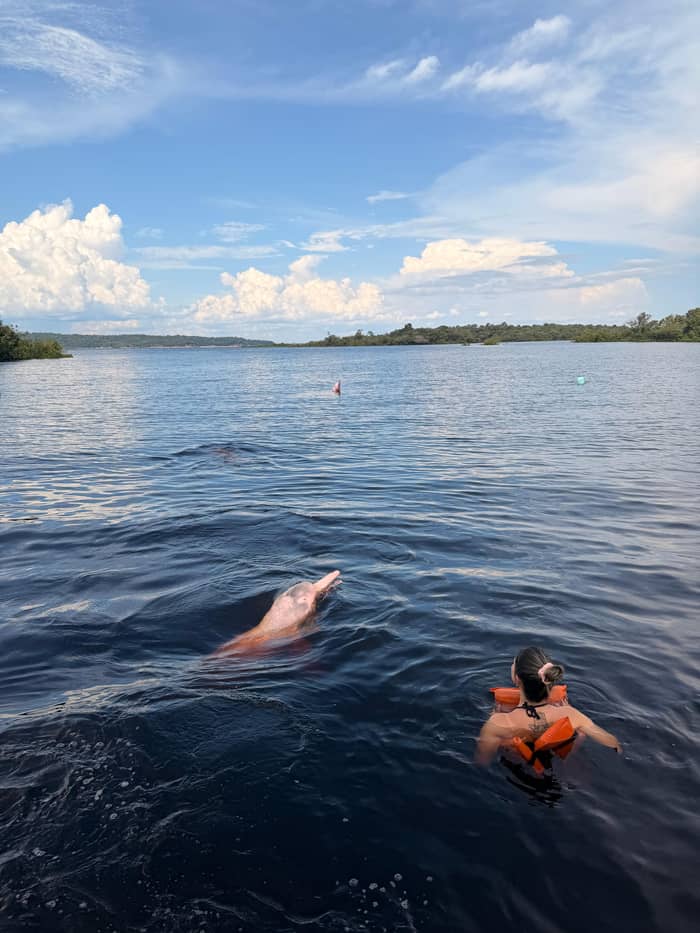
Close-up
Closer passes, shared space
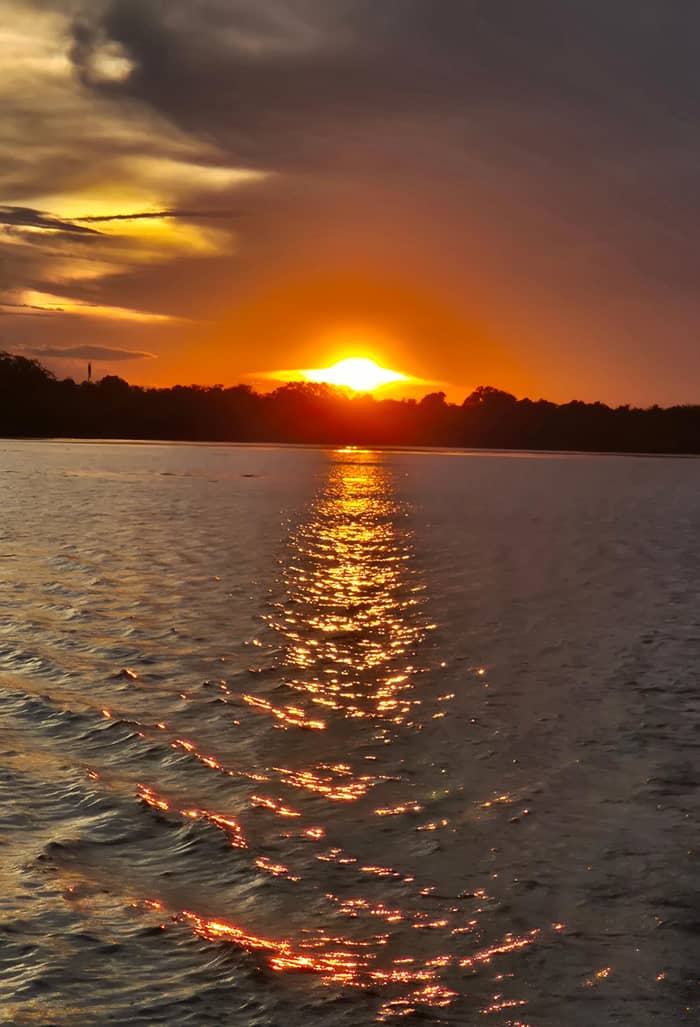
Booked here
Our jungle day dolphin stop
Each setting suits a different kind of picture. A canoe watch gives you the wide, quiet shot of a back breaking the surface against the forest. The full river day includes dolphin watching from canoes, while the Negro River half day pairs a dolphin project with a white sand beach. Both give you lakes and channels as backdrops.
A platform gives you closer pictures, with a risk of crowding at the edge. A safari-style day brings guests to a platform for a swim after the meal, while a speedboat day has them swimming close to the dolphins from a floating platform. The speedboat record also rules out touching the dolphins and posing for pictures with the wild animals, so read the rule of the stop you booked.
In the water, waterproof housings and cameras with a strap help, but your priority is the animal rather than the shot. On our jungle day the dolphin project comes once lunch is over and before the piranha fishing, and swimwear and a towel go along for it. Ask the guide whether a phone is welcome in the water and who can take a group picture from the platform. Pink dolphin Amazon river videos filmed from a platform look very different from those filmed from a canoe, because the distance and the angle are so different.
Price your party
Pick a party size and compare the days with a dolphin stop.
Compare 4 side by side
Pick a party size and compare the days with a dolphin stop.
≈
View≈
View≈
View≈
ViewStarting prices as on the booking platform, converted at the ECB reference rate. You see the exact price at booking.
The light on the water changes the picture more than the camera. Overcast skies give soft even tones on a dark river, bright midday sun flattens the surface and bounces off the spray, and low sun gives warm color to the water and the forest. Dolphin stops are scheduled by the operator, so you rarely choose the hour, and a polarizing filter is a cheap way to control reflections.
The weather is part of the plan. Our jungle day listing describes a hot, rainy and humid region and asks for a raincoat and sunscreen. Rain is lightest in the dry months, though the long-term INMET means show it never stops.10 Expect humidity to fog a cold lens, so let your gear acclimatize in the open air before you shoot.
The day does not end at the dolphin stop. After it comes piranha fishing and a ride until sunset, and the ride gives you warm light on the water and the forest. The sky itself is a good subject at that hour, and a long day drains a phone, so bring a spare battery and keep it dry. Review your frames after the trip, not while you are afloat and the next surfacing may arrive.
Video
Maria Wilkinson Photography on YouTube · The video stays unloaded until you press play.
Botos must come to the surface regularly to breathe, but can stay submerged for long periods.
A search for a pink dolphins in the Amazon video leads to clips that were filmed in very different ways. Some show a dolphin in the wild, and some show a feeding stop with fish in a hand. A clip of a dolphin hand-fed at a float tells you little about how the animal lives in the river, so look at the setting before you judge what the animal is doing.
Shoot video the way you would shoot stills. Record a few seconds before and after a surfacing and keep the camera steady, because the sound of a breath and the ripple of a dive are part of the story. If you share the clip, name the species as the boto or Amazon river dolphin, and caption the setting honestly as a tour stop rather than a natural encounter.
Keep welfare ahead of the picture, whatever the angle you are after. An article hosted by ICMBio calls lifting a boto out of the water for a better shot mistreatment, and says several norms forbid it.3 The species is assessed as Endangered on the Brazilian list.7 A picture that shows a dolphin calm in its own water says more about the animal than one that has been grabbed.
FAQ
A boto surfaces regularly but dives for long periods, so use burst mode and pre-focus where you saw one surface.1
Calves are dark grey, and sexually active adult males are much pinker.2
One speedboat record rules out touching them and posing for pictures with the wild animals.
An article on the ICMBio site says holding botos out of the water for a picture may count as mistreatment.3
The canoe has no cover, so use a dry bag and a lanyard to keep a phone safe.
The species maximum is 2.55 m and 200 kg for a male and 2.25 m and 155 kg for a female.4
The jungle day lists a dolphin project and a ride until sunset.
Sources
Wondering how a day with the pink dolphins works? Ask a real person here.