Hands-on
Swim at the project
Enter the water with a guide
- GearSwimsuit and towel
- Length12 hours
- RuleAsk about touching
Guides
Language
Currency
Find open datesfrom $140 · free to cancelPacking and prep checklist
Quick summary
You can swim with pink dolphins in the Amazon on some Manaus tours, but a federal decree forbids molesting cetaceans and researchers warn against feeding and grabbing them.
Swim essentials
Checklist · 9 points
Tick off each point as you complete it. This device keeps your progress.
0 / 9 ready
You are good to go. Pick your date for the jungle day, and the rest is settled.
Secure your spotSeveral Manaus tours let you enter the water with wild botos. Here is how that works, what the official sources say about feeding and touching, and how to keep the animals and yourself safe.
Editorial team, pinkdolphinsamazon.quest · Updated November 12, 2026 · 6 min of reading
Summary view
People ask: can you swim with pink dolphins? Several Manaus listings answer yes in some form. Our jungle day stops at a dolphin conservation project where guests have the chance to enter the water, and the listing asks for swimwear and a towel for that stop. A full river day of 9 hours describes the same chance, and a 2-day river tour does too.
The format differs between operators. A safari-style day of 7 hours moves guests to a platform for a swim once lunch is over, and a speedboat day describes swimming near the dolphins from a floating platform. The ICMBio assessment says botos are attracted and domesticated in various Amazonas locations so that visitors can meet them, and a separate ICMBio note says the contact on the lower Rio Negro rests on food offered to the dolphins.4,5
None of this is new. A well documented example is Novo Airão, where an ICMBio researcher traces the contact to 1997, when the daughter of a floating restaurant owner began feeding a boto that visited the spot.6 The activity ran without any norm or inspection to protect the animals or the visitors, and INPA has noted four other floating platforms in Amazonas that offer contact with botos.6,7
What the records say
| Day | The contact described | Rule note |
|---|---|---|
| Our jungle day | Project, chance to enter the water | Ask about touching |
| Safari-style day | Platform swim after lunch | Ask about touching |
| Speedboat with lunch | Swim near them, no touching | Welfare rule stated |
| Negro half day | Enter the water and touch | Molesting is prohibited1 |
| Small-group trip | Feeding described | Feeding rules vary13 |
| Full river day | Canoe watching, swimming listed | Ask about the platform |
Listing wording as recorded; the rule notes come from the federal decree and the ICMBio researcher.1,13
The boto is a large wild animal, and the numbers show why a guide wants the group calm. Males can reach 2.55 m and 200 kg, and females stay smaller, at 2.25 m and 155 kg.10 Size and strength alone are reasons to respect the space around them, and a guide who asks the group to stay calm and keep its distance from the head and tail is doing the job properly.
The ICMBio researcher who wrote about tourism with botos lists real injuries. Tourists can be hurt, without anyone meaning it, by the fast movements and leaps of the animals or by contact with their teeth.2 Those problems were described at the feeding float in Novo Airão, and a researcher at INPA said the dolphins show more aggression toward each other when they compete for food handed out by people.11
There is also an open health question. An ICMBio research project on the breathing-hole microbes of botos from several rivers began in order to check whether animals that interact with people on the Negro could pass a pathogen to the people who touch them.12 No result is stated, so treat it as a reason for care rather than a finding. If you have a fresh cut or feel unwell, tell the guide and skip the water.
Ratings
Average rating as each listing shows it, from 117, 485, 67, 20 and 431 reviews.
At the federal level, all cetaceans are protected from hunting by law 7.643 of 1987.15 A biologist quoted in an article hosted by ICMBio points to Decree 6.514 of 2008, whose article 30 prohibits intentionally molesting any species of cetacean, a ban that covers botos, whales and dolphins and carries a fine.1 Molesting is the legal word, and it is broader than harming.
Feeding is less clear. According to the same biologist, no Brazilian law prohibits feeding wild animals in conservation units, but the internal regulations of some units ban the practice.13 The article adds that lifting botos clear of the water for a snapshot or offering foods that are not part of their diet, such as snacks and bread, can be considered mistreatment and is prohibited by several specific norms.9
At the state level, the conservation assessment of the species records that a state regulation on organizing tourism with botos already exists.16 That means the rules a stop follows can differ from one place to another, so ask the operator which ones apply and who authorizes the stop. A good guide answers without hesitation, and a vague answer is information too.
Pick your contact
Say how you feel about the water and see which stop fits.
If I want to enter the water
The jungle day
A dolphin project with the chance to enter the water.
If I want no touching at all
A stop with a no-touch rule
One speedboat record rules out touching.
If I would rather watch from the canoe
The full river day
Its record lists dolphin observation from canoes.
If I do not want to feed anything
Say so when you book
Offering food to botos is described as a problem by researchers.2
If I want a regulated setting
The INPA platform
It was built to regulate hours and set low-impact rules.14
Ways to meet them
Hands-on
Enter the water with a guide
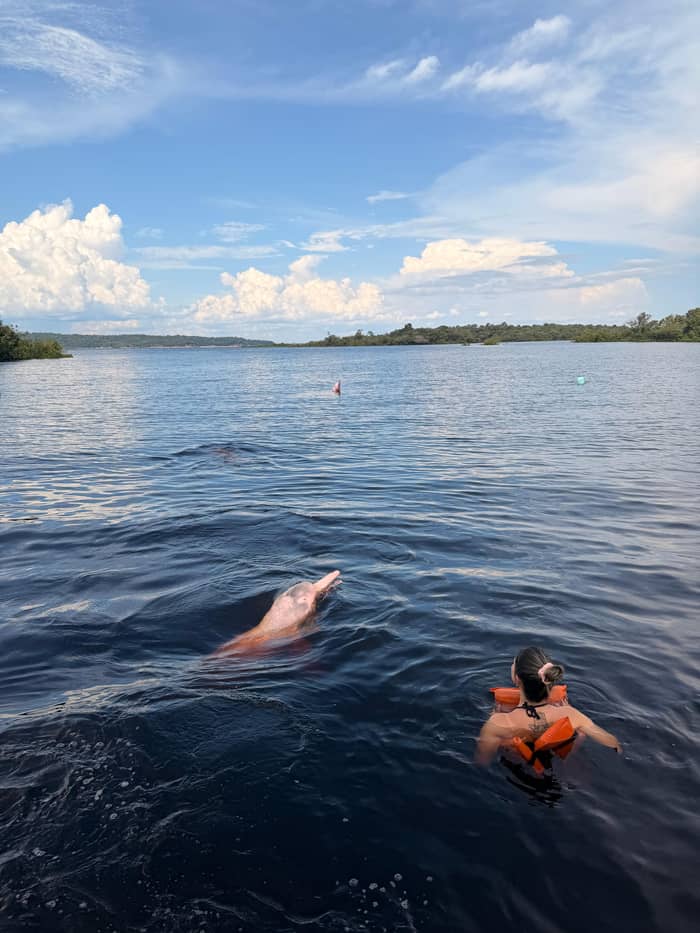
Low contact
Dolphin observation on a river day
No swim
River day for limited mobility
The problems described by researchers are concrete. Botos at a feeding float can receive more food than they need, swallow plastic bags and objects that fall in the water, or get hurt on the edge of the float.2 Some tourists lift a boto into the air as it takes a fish, hoping for a better photo, and others hand it snacks.9
The wider picture matters too. ICMBio assesses the species as Endangered on the Brazilian list, with a decline of at least 50% suspected over three generations of 69 years from the year 2000.3,17 An animal under that pressure does not need an audience that crowds it for food and photographs, and a tourist stop that depends on offering fish asks the animals to change how they behave in the wild.11
Some listings do describe touching or feeding. One half day describes entering the water and touching the dolphins, and a small-group trip describes feeding them. We would not book a stop built around feeding. Another listing takes the opposite line, ruling out touching and speaking of respect for the welfare of the regional fauna.
Price your party
Choose a party size and compare days that include a dolphin swim.
Compare 4 side by side
Choose a party size and compare days that include a dolphin swim.
≈
View≈
View≈
View≈
ViewStarting prices as on the booking platform, converted at the ECB reference rate. You see the exact price at booking.
The swim step by step
Before the stop
Ask who leads the stop and what the rules are for touching.
At the stop
Swimwear and a towel go with you to the dolphin stop.
In the water
The boto surfaces regularly and can stay under for long periods.8
Hands off
Holding a boto clear of the water for a photo counts as mistreatment.9
Afterwards
On our jungle day the piranha fishing and the sunset ride follow.
Researchers have described what a better setup involves. An ICMBio working group proposed that tourism with botos happen only inside conservation units, with a favourable opinion and monitoring by the managing body, and that rules cover the number of tourists, the minimum structure, the location of the float and the time of observation.18 It also called for stricter rules on touching and feeding.18
A research platform run by INPA near Manaus follows that spirit. It was designed to regulate visiting hours and to set low-impact rules for the interaction, and it carries signs and information in Portuguese and English about the animal, its habitat and its threats.14,19 The platform is in the village of São Thomé, in Iranduba municipality, 80 km from the city, so it is a separate outing from the day tours.20
A separate ICMBio research project in the lower Rio Negro aims to monitor tourist interactions with pink dolphins and caimans and to propose ways to reduce their negative impact.21 Its stated goal is qualified, low-impact activities that contribute to the welfare of the species, visitor satisfaction and income for local communities.22 That is the direction to look for when you choose an operator.
Video
Predatory Fins on YouTube · The video stays unloaded until you press play.
These attitudes can be considered mistreatment of the animals, and are prohibited by several specific norms.
Start with the briefing. Ask the guide how many people enter the water at a time, how long the stop lasts and what the rules are for touching. Pack what the listing names for the dolphin stop, swimwear and a towel, and shade for the head and skin on a canoe with no roof. Ask whether life jackets are provided and whether the water is shallow enough to stand in. Keep jewelry and loose items out of the water, since researchers say objects that fall in can be swallowed.2
In the water, stay still and let the animal choose to come; keep your hands to yourself. Do not grab a dolphin, hold it up for a photo or offer it food.9 Keep movements slow and your voice low, and give the dolphin room to leave. A boto must surface regularly to breathe and can dive for long stretches, so it is free to disappear whenever it likes.8
If the swim is not for you, ask for a watch from the canoe instead. The full river day lists dolphin observation from canoes along with its other stops. The jungle day listing itself steers anyone with limited mobility toward a river day tour instead of the long day. Either way the dolphins remain wild, and a calm sighting is a good one.
FAQ
Our jungle day lists a dolphin project with the chance to enter the water, and so do several river days.
Decree 6.514 of 2008 prohibits intentionally molesting cetaceans.1
No federal law bans feeding in conservation units, but some units ban it in their own rules.13
Tourists can be hurt by the fast movements, leaps and teeth of the animals.2
Males top out at 2.55 m and 200 kg, females at 2.25 m and 155 kg.10
ICMBio assesses the species as Endangered, category dated 18/05/2018.3
The jungle day listing names swimwear and a towel, plus sunscreen and a hat for the open canoe.
Sources
Wondering how a day with the pink dolphins works? Ask a real person here.