Youngest
Calf
Dark grey
See the optionsGuides
Language
Currency
Find open datesfrom $140 · free to cancelChoosing helper
One tap to a dolphin day
Say how much of the day you can give, and a listing with a pink river dolphin stop appears with its from-price.
Your ideal pick
from $110
It lists 4.5 hours with the chance to swim with pink river dolphins.
Your ideal pick
from $140
It lists 9 hours with time at a pink river dolphin research base.
Your ideal pick
from $140
It lists 12 hours with a dolphin swim, a jungle trek and a night ride.
The boto starts life dark grey and ends up bright pink, if it is a mature male. Here is what the official assessments say about colour, age, scars and where to look for each shade.
Editorial team, pinkdolphinsamazon.quest · Updated November 12, 2026 · 6 min of reading
Summary view
Yes, and they are not a trick of the light or a photographic filter. The IUCN's own list of English names for the species includes Pink Dolphin, next to Amazon River Dolphin, and the Brazilian names boto-vermelho and boto-cor-de-rosa say the same thing in Portuguese.4,5 The animal is a true freshwater dolphin of the Amazon and Orinoco rivers, and pink is the colour its skin reaches in some individuals.6
The point of the question is that people ask it expecting a single answer, and the answer is a range. ICMBio describes a colour that runs from dark grey up to bright pink, and that shifts with the age and the sex of the animal.1 A dolphin that looks grey in your photograph is not a different species, and neither is a salmon-pink animal. It may simply be a younger animal, a female, or a male at an earlier stage.
When someone says dolphins in the Amazon are pink, they are usually thinking of the adult males that come close to boats near Manaus. The smaller tucuxi that shares the river is grey and is never described as pink in the sources.7 So if every dolphin you see is small, grey and quick to leap, you are probably looking at tucuxis, and the pink boto may be a little further along the bank.
Colour by stage
| Animal | Colour | What the sources say |
|---|---|---|
| Foetus and calf | Dark grey | Foetuses and calves are dark grey.2 |
| Newborn calf | Dark grey | Born at about 78 to 90 cm after a long pregnancy.8 |
| Young adult female | Between grey and pink | Colour varies with age and sex; breeding starts from 7 years.1,3 |
| Adult male | Much pinker | Pigment loss from abrasion and scars.2 |
| Tucuxi (other species) | Grey | The smaller grey river dolphin of the same rivers.7 |
The sources give no colour for young females beyond the range from dark grey to bright pink, so that row reads as a range.1
No. Foetuses and calves are dark grey, and the colour develops as the animal grows up.2 Gestation takes an estimated 12.3 to 13 months, and the newborn, about 84 cm on average within a range of 78 to 90 cm, stays close to its mother in the quieter lakes and side channels.8,9 A newborn is therefore the least pink animal you could see, and a mother with a calf is often not the rosy picture a travel poster would suggest.
As the dolphin matures, the picture changes, but not at the same pace for both sexes. Females can breed from 7 years and 170 to 180 cm; males follow later, maturing sexually from 10 years and 190 to 200 cm.3 ICMBio says it is the adult, sexually active males that are generally much pinker than the rest.2 So a pink boto at the side of the boat is, as a rule, a mature male, an animal that has lived through years of social contact.
Time scales matter here, because a boto can live a long time. Tooth layers point to 45 years in the wild, while a captive male in Germany reached 52 years.10 A male that survives into adulthood therefore carries his colour for decades. When a guide tells you the dolphin beside the boat is an old male, that statement fits what the assessments say about how long these animals live and how their colour changes. An adult male reaches at most 2.55 m and 200 kg, while a female reaches 2.25 m and 155 kg.11
The Brazilian assessment gives a physical cause. Adult males turn pink because of an intense loss of pigment, which comes from abrasion and from scars left by confrontations within the species.2 In plain terms, the pink is partly the colour of skin that has been scraped and healed, again and again, over the years. That is quite different from the idea of a dolphin that is pink because of what it eats or because of the sun, and the official sources do not support those explanations.
The IUCN says something similar from the researcher's point of view. Intense interactions between individuals leave marks and scars on the animals, and scientists have thought about using them to tell dolphins apart in photographs.12 The assessment adds that identification by marks works for only part of the population, so a scar pattern is no guarantee of recognition.12 For a visitor, the lesson is simple: a boto with a pale pink, mottled body has a history written on its skin.
The social life behind the scars is unusual. According to ICMBio, adult males woo females by presenting sticks, branches or lumps of mud, a courtship display no other aquatic mammal is known to share.13 A male that spends years in this kind of contest, in water where visibility is poor, is a male whose skin takes damage. The sources do not tie the display to the colour directly, so treat the link as context rather than a proven cause.
Know them by colour
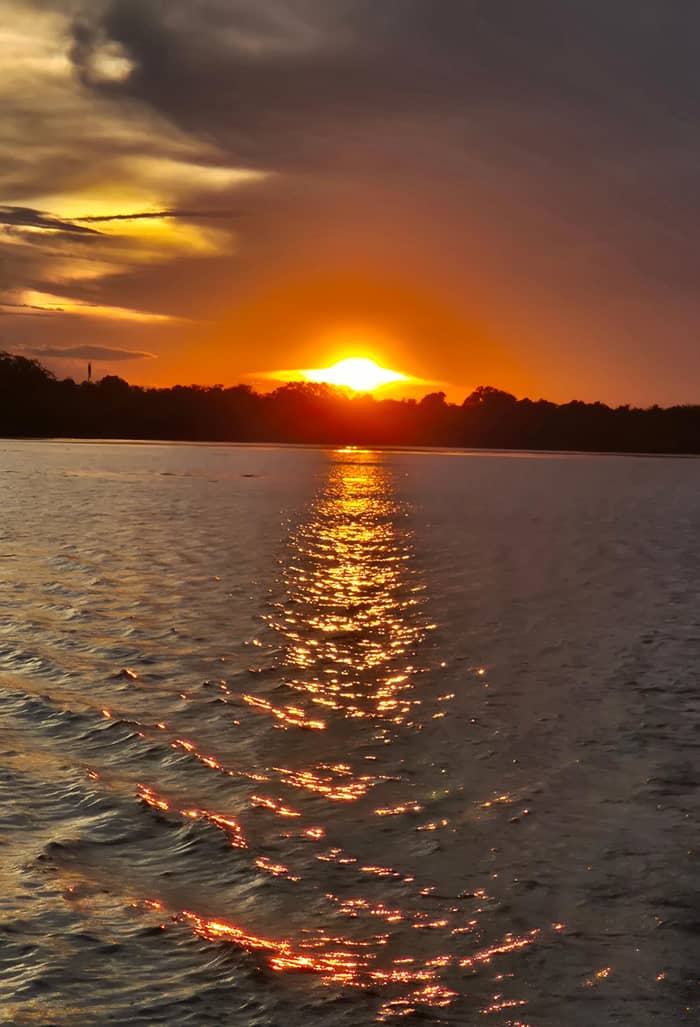
Youngest
Dark grey
See the options
Mothers
Between grey and pink
See the options
The pink ones
Much pinker
See the optionsBecause colour follows age and sex, and because the sexes do not use the river in the same way, you can make a sensible guess about where to expect each shade. The IUCN reports that mothers with calves favour flooded forest, lakes and side streams during high water, whereas the adult males are mostly out in the main channels.9 Greyer animals, calves and their mothers, are therefore likelier in the quiet lakes, and the pink adult males in the open channel.
That is useful if you plan a trip. In the main river the animals most often stay within 150 m of the bank and at low water they gather below channel confluences, which is where a boat can find a bigger, pinker male.17,18 At high water a canoe that enters a flooded lake or a flooded forest is more likely to meet a mother and a grey calf, an encounter that asks for more distance, not less.19,9 None of this is a promise. Dolphins move, and some dolphins stay put in a home area throughout the year while others roam widely, tens to hundreds of kilometres along the river.20 Use the colour guide to read what you see, not to predict a sighting. Use the quiz above to match a day to your hopes, from a short Rio Negro outing to a full day with a dolphin project.
Go and look
Choose a party size to see the from-prices of the dolphin outings.
Compare 3 side by side
Choose a party size to see the from-prices of the dolphin outings.
≈
View≈
View≈
ViewStarting prices as on the booking platform, converted at the ECB reference rate. You see the exact price at booking.
A boto's colour over a lifetime
Before birth
Foetuses are already dark grey.2
Birth
Calves average 84 cm at birth.8
Nursing years
Mothers with calves favour lakes and flooded forest at high water.9
Maturity
Males reach sexual maturity at 190 to 200 cm.3
Adult life
Pigment loss comes from abrasion and scars from fights.2
A bright pink dolphin looks like a symbol of a healthy river, but the assessments tell a different story. The IUCN rates the species Endangered in an assessment from 2018, which replaced a long period of uncertainty about its status.21,22 ICMBio also lists it as Endangered, and the most serious human-caused threat is killing for fish bait.23,24 A colourful animal does not make the population strong.
There is another reason not to treat colour as a sign of health. Scars that make an animal pinker come from fights and from contact with hard surfaces, and at tourist platforms the botos can get hurt on the platform's edge or swallow items that drop into the river.15 A pink skin may be an old injury, and a guest who feeds or touches a boto may add to the damage. The ethics are covered on the endangered page and on the swimming page of this site.
What you can do is simple. Keep your distance, do not feed or handle the animals, and choose operators who explain the rules before the boat stops. Feeding also makes animals ill and puts them in the path of boats, as the IUCN warns.14 That is a better way to enjoy a pink dolphin than a handful of fish held over the side of a boat, and it leaves the animals as wild as you found them. If a platform advertises feeding, ask what the rules are before you pay.
Video
National Geographic on YouTube · The video stays unloaded until you press play.
Inia bear marks and scars that have potential for being used in photo-identification studies
On the water
FAQ
Adult males lose pigment through abrasion and scars from fights within the species, so they turn pink.2
Foetuses and calves are dark grey, and adult males become much pinker.2
Their colour varies from dark grey to bright pink with age and sex.1
The other Amazon river dolphin, the tucuxi, is smaller and grey.7
The species is Endangered on the IUCN Red List despite its appearance.21
Boto habitat includes the Rio Negro, where the 12-hour day trip lists a swim with pink river dolphins.25
Sources
Wondering how a day with the pink dolphins works? Ask a real person here.